



The Science Behind Cartalax Peptide Explained
Cartalax is a short synthetic peptide bioregulator developed in the Khavinson school of Russian peptide research and studied for its proposed role in cartilage and connective-tissue regulation. This guide explains what the cartalax peptide bioregulator is, how its mechanism is thought to work, what the preclinical research actually supports, how it compares to Sigumir, and how to source research-grade material with a verifiable Certificate of Analysis.
Editorial & research disclaimer: This article is for educational purposes only and is not medical advice. Cartalax is a research compound and is not approved for human therapeutic use in the United States, the EU, or most jurisdictions. Always consult a licensed healthcare professional and verify local regulations before handling any peptide.

Quick Answer
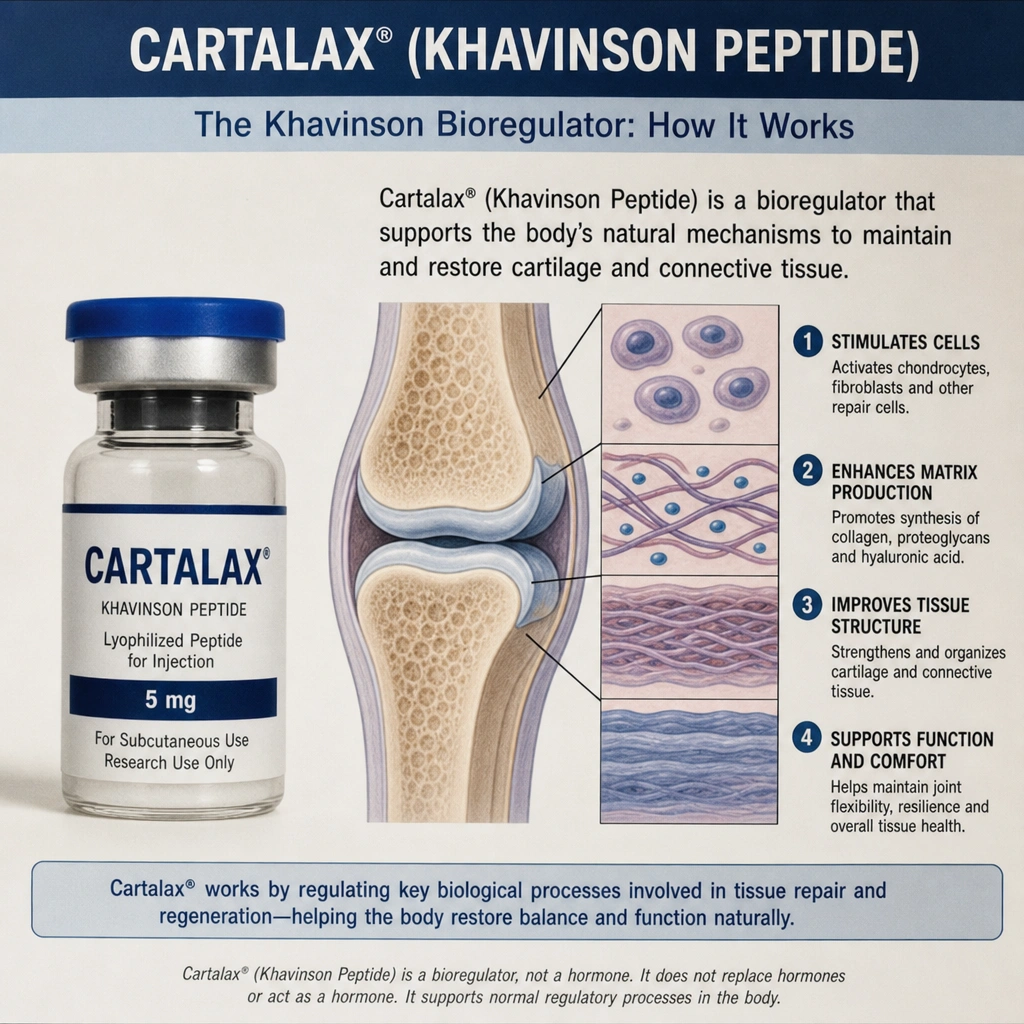
What is Cartalax? Cartalax is a short peptide bioregulator from the Khavinson family of Russian peptides, commonly cited with the amino-acid sequence Ala-Glu-Asp (AED) (some suppliers list a longer Ala-Glu-Asp-Gly variant). It was designed by analyzing natural tissue extracts and is studied as a cartilage bioregulator proposed to influence gene expression in chondrocytes and cartilage tissue cells.
Evidence regarding its role in cartilage homeostasis is largely preclinical and originates mainly from its developing institute. Cartalax is sold for research use only and is not an approved medicine. Source it only from suppliers that publish a batch-matched COA with 99%+ purity and 99%+ HPLC purity.
Cartalax is a Khavinson-class peptide bioregulator studied for cartilage and connective-tissue support, not an approved drug.
Mechanism is epigenetic by hypothesis: short peptides in this family are proposed to bind DNA regions and modulate tissue-specific gene expression.
Evidence is preclinical. Most data come from the originating Russian research school; there are no large independent human trials.
Cartalax vs Sigumir: both target the musculoskeletal/cartilage system; Cartalax is a defined synthetic peptide, Sigumir is a natural peptide complex.
Buy on proof. Choose research-grade Cartalax with a batch-specific COA, 99%+ HPLC purity, and cold-chain shipping.
What Is Cartalax?
The cartalax peptide bioregulator is a synthetic short-chain peptide associated with Professor Vladimir Khavinson and the St. Petersburg Institute of Bioregulation and Gerontology. It belongs to the same research tradition as the cartalax peptide khavinson studies and other Khavinson bioregulators and bioregulatory peptides such as Epitalon, Cortagen, and Vesugen, which were created by isolating the shortest active fragments of natural tissue bioregulatory peptides.
The most commonly cited sequence for Cartalax is the synthetic tripeptide Ala-Glu-Asp (AED), featuring alanine, consisting of alanine, glutamic acid, and aspartic acid, though some suppliers and write-ups list a longer Ala-Glu-Asp-Gly variant. Because reported sequences differ across sources, you should confirm the exact sequence and molecular formula on the supplier's Certificate of Analysis rather than assuming it. In every case it is studied as a cartilage tissue and connective-tissue bioregulator, often in relation to joint stiffness.
Like all peptides, Cartalax is a chain of amino acids that acts as a biological signal. At three to four residues it has an extremely low molecular weight, which is central to the Khavinson hypothesis that such peptides can reach the nucleus and interact with DNA.
How Does Cartalax Work? Mechanism of Action
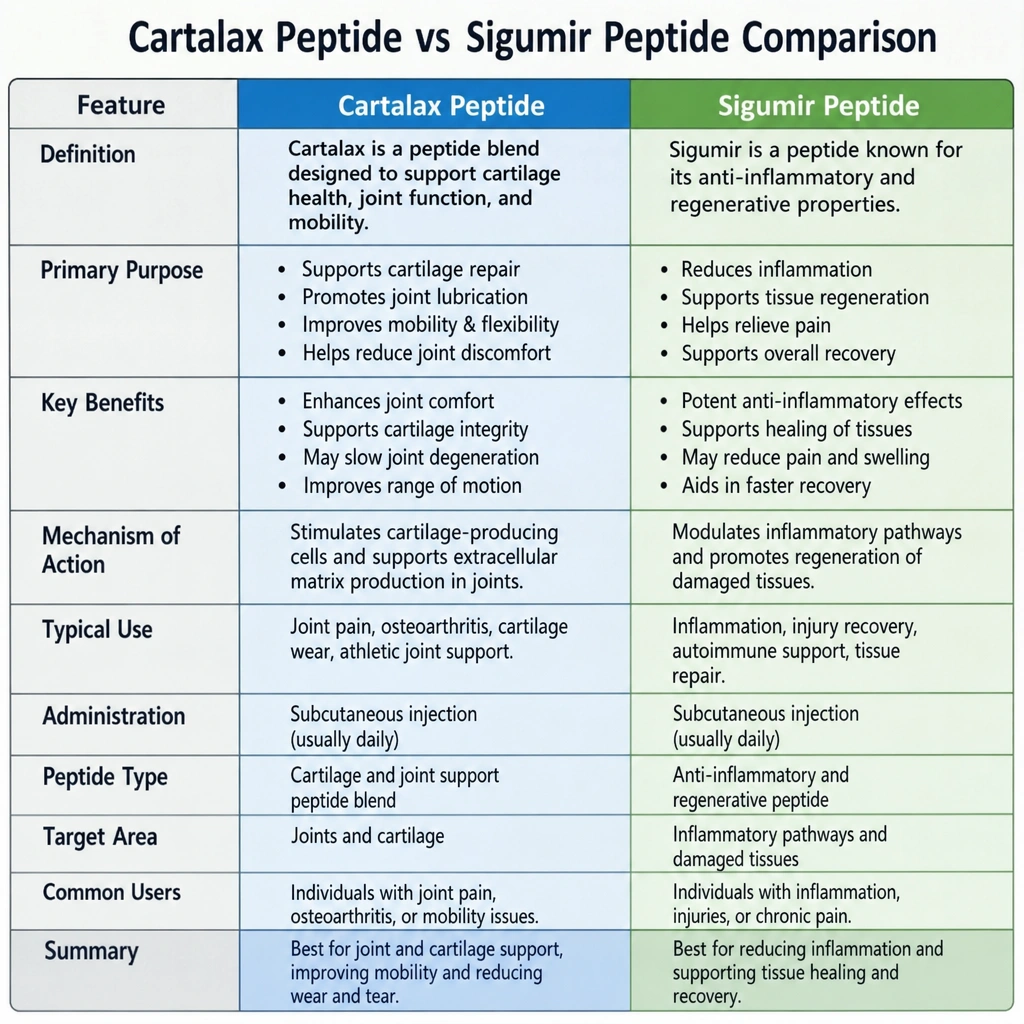
According to the Khavinson model, ultra-short peptides like Cartalax are proposed to bind specific promoter regions of DNA and influence the expression of tissue-specific genes — an epigenetic mechanism rather than classic receptor activation. For Cartalax, the proposed target tissues are cartilage and the surrounding connective-tissue matrix.
In practical research terms, investigators have examined whether Cartalax can modulate activity in chondrocytes (cartilage cells) and fibroblasts to support cartilage integrity, aggrecan, matrix metalloproteinase levels, and extracellular matrix components, potentially relevant to conditions like mechanical stress, degenerative changes, cartilage degeneration, osteoarthritis, joint pain, and the structural matrix of the musculoskeletal system. These are mechanistic, preclinical observations. They describe what is being studied, not proven clinical outcomes in humans.
It is worth being precise here: a hypothesis about gene regulation is not the same as a demonstrated therapeutic effect. Marketing that jumps from “modulates chondrocyte gene expression in a model” to “rebuilds your joints” or claims specific cartalax peptide benefits like facilitating cartilage repair or cartilage regeneration overstates the evidence.
What Does the Research Actually Say?
Cartalax has been investigated for several proposed effects, summarized below with the caveat that the evidence base is largely preclinical and concentrated in its originating research school.
- Cartilage / connective tissue: studied as a regulator of chondrocyte and matrix activity.
- Anti-inflammatory signaling: examined in the context of chronic inflammation, inflammatory cytokines, musculoskeletal issues, and oxidative stress in models.
- Gene-expression / epigenetic activity: the core of the Khavinson hypothesis, observed in laboratory research systems
- Geroprotection: explored within the broader peptide-bioregulator literature for its potential to influence SIRT6, genomic stability, cellular resilience, cellular senescence markers, and other markers of cellular aging.
The honest limitation: there are no large, independent, randomized human clinical trials establishing efficacy or a human safety profile for Cartalax. Treat strong disease claims as marketing, not science, and keep your own expectations calibrated to the strength of the evidence.
Cartalax vs Sigumir: How Do They Compare?
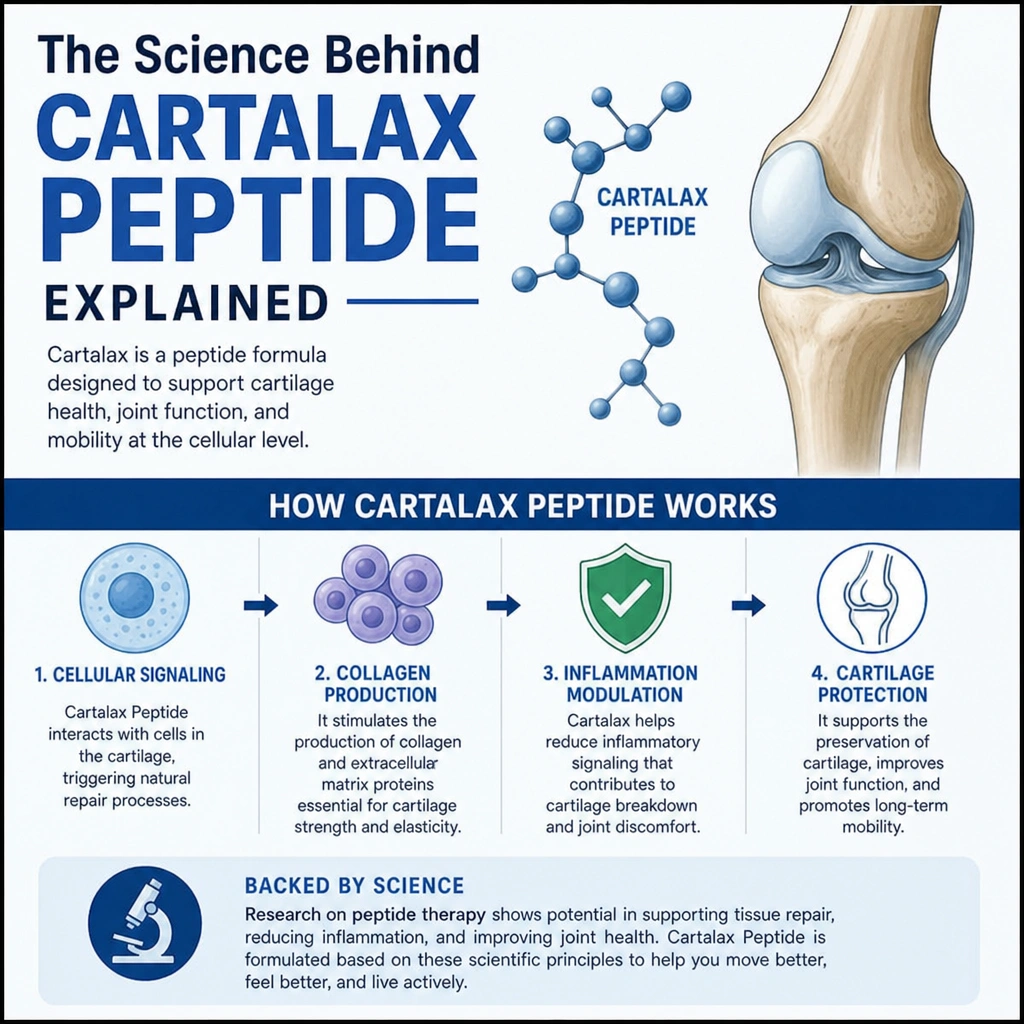
Sigumir is another Khavinson-family bioregulator aimed at the musculoskeletal and cartilage system, which is why the two are often compared, much like researchers compare Cartalax to BPC-157 for tissue repair. The key practical difference is composition: Cartalax is a defined synthetic peptide, while Sigumir is a natural peptide complex extracted from animal cartilage and bone tissue.
| Factor | Cartalax | Sigumir |
|---|---|---|
| Type | Defined synthetic short peptide | Natural peptide complex (extracted) |
| Target tissue | Cartilage & connective tissue | Cartilage, bone & connective tissue |
| Proposed mechanism | Epigenetic gene-expression regulation | Tissue-specific peptide signaling |
| Form | Lyophilized vial (research) or capsules | Capsules (bioregulator complex) |
| Evidence base | Preclinical, originating school | Preclinical, originating school |
| Status | Research use only | Research / supplement (region-dependent) |
Peptide Bioregulators vs Traditional Joint Supplements
Buyers often weigh Cartalax against familiar joint health and cartilage health supplements like glucosamine and chondroitin. They work on different premises: traditional supplements supply structural raw materials, whereas peptide bioregulators are hypothesized to act as signals that influence how cartilage cells behave. Neither approach is a substitute for medical care, and the bioregulator evidence remains preclinical.
- Glucosamine / chondroitin: widely available supplements that provide cartilage building blocks; mixed clinical evidence.
- Collagen peptides: food-grade powders supplying amino acids for connective tissue.
- Cartalax / bioregulators: research compounds like BPC-157 or AED proposed to act on gene expression; not approved, preclinical evidence only.
Cartalax Dosage and Administration (Research Context)
Because Cartalax is not an approved medicine, there is no established human cartalax peptide dosage, cartalax peptide protocol, or standardized cartalax dosing protocol. Protocols described online come from research and supplier literature, not regulatory guidance, and should be treated as research parameters only. If you are evaluating Cartalax, use the supplier's documentation and a peptide reconstitution calculator to work accurately, and consult a professional.
- Confirm the format — lyophilized powder for reconstitution, or an oral bioregulator capsule, as supplied.
- Reconstitute (injectable research form) with bacteriostatic water per the supplier's ratio, swirling gently.
- Follow the supplier's stated cartalax dosing protocol for amount and frequency; do not extrapolate from anecdote when designing your cartalax peptide protocol.
- Store correctly — cold and dark, with reconstituted solution refrigerated and used within the stated window.
- Track and document objectively if running a research protocol.
Where to Buy High-Quality Cartalax Safely
Quality varies enormously for research peptides, so buy on documentation, not price. Verify a batch-specific COA showing 99%+ HPLC purity and independent third-party testing, cleanroom lyophilization, and cold-chain shipping before purchasing.
| Factor | High-Quality (Verified) | Low-Quality / Offshore |
|---|---|---|
| Purity | 99%+ by HPLC, identity confirmed | Unverified or below 95% |
| COA | Batch-specific, recent, third-party | Missing, generic, or undated |
| Sequence disclosure | Stated and matches COA | Vague or inconsistent |
| Shipping | Cold-chain where required | Ambient; degradation risk |
| Labeling | Clear “research use only” | Mixed medical claims |
You can use PrymaLab's Cartalax research listing and broader bioregulator catalog as a reference point for the transparency standards a trustworthy supplier should meet.
Researching cartilage bioregulators? Start with verified material.
PrymaLab focuses on US-handled research peptides with transparent, batch-specific COAs and cold-chain shipping.
Explore PrymaLab BioregulatorsFrequently Asked Questions
What is Cartalax and who developed it?
Cartalax is a short synthetic peptide bioregulator from the Khavinson school of Russian peptide research, associated with the St. Petersburg Institute of Bioregulation and Gerontology. It is commonly cited with the sequence Ala-Glu-Asp (AED) and is studied as a cartilage tissue and connective-tissue bioregulator. It is sold for research use only and is not approved for human use.
How is Cartalax thought to work?
Under the Khavinson model, ultra-short peptides like Cartalax are proposed to bind specific DNA regions and modulate tissue-specific gene expression — an epigenetic mechanism rather than classic receptor activation. For Cartalax the proposed targets are chondrocyte signaling and connective-tissue cells. This mechanism is hypothesized from preclinical work, not proven in human trials.
What does the research on Cartalax show?
Most Cartalax data are preclinical and come from its originating research school, examining cartilage-cell activity, cell proliferation, igf1 signaling, chondrocyte apoptosis, cartilage matrix synthesis, and gene-expression effects in models. There are no large independent randomized human clinical trials, so efficacy and a human safety profile are not established.
Cartalax vs Sigumir — which should I research?
Both target the cartilage and musculoskeletal system. Cartalax is a defined synthetic peptide; Sigumir is a natural extracted peptide complex. The choice depends on your research question and the format you need. Neither is an approved treatment, and both rest on preclinical evidence.
Is Cartalax legal to buy?
In most regions Cartalax is sold strictly as a research compound and is not approved for human therapeutic use. Laws vary by country and state, so confirm your local regulations before purchasing. Legitimate suppliers label it for research use only and require age verification.
What purity should research-grade Cartalax have?
Look for 99% purity or higher by HPLC with identity confirmation, documented on a batch-specific COA from an independent lab. Anything below 98% is a yellow flag and below 95% is a hard pass. A generic, self-reported “purity certificate” with no chromatogram is not sufficient.
How should I store Cartalax?
Keep lyophilized Cartalax cold and dark; many researchers refrigerate or freeze unopened vials. After reconstitution with bacteriostatic water, refrigerate, protect from light and heat, and use within the supplier's stated window. Use sterile technique throughout.
Does Cartalax have side effects?
Because there are no published human clinical trials, the human side-effect profile and potential cartalax peptide side effects are not established. Preclinical reports suggest low toxicity, but that does not confirm human safety. It remains a research compound; consult a licensed professional and verify legality before any use.
References & Further Reading
- Khavinson, V.Kh. (2002). Peptides and Ageing. Neuroendocrinology Letters, 23(Suppl 3), 11–144.
- Khavinson, V.Kh., & Malinin, V.V. (2005). Gerontological Aspects of Genome Peptide Regulation. Karger, Basel.
- Anisimov, V.N., & Khavinson, V.Kh. (2010). Peptide bioregulation of aging: results and prospects. Biogerontology, 11(2), 139–149.
- Review literature on short peptide bioregulators and chondrocyte gene expression, including effects on CD98hc, proteoglycans, type II collagen, and the alpha-1 chain of type XI collagen (AED-class peptides).
- U.S. Food and Drug Administration. Compounding and the FDA: Questions and Answers. FDA.gov. Accessed 2026.
PrymaLab resources: Cartalax research listing · Bioregulator peptides · Research Hub · Peptide calculator · FAQ.
Final disclaimer: This article is for educational purposes only. Cartalax and the other compounds discussed are sold for research purposes only and are not approved by the FDA or comparable agencies for human therapeutic use. Statements about their effects have not been evaluated by the FDA.
Always consult a licensed healthcare professional before starting any new health protocol, and verify the legal status of any compound in your jurisdiction. PrymaLab does not endorse any specific third-party peptide vendor mentioned in this article and assumes no responsibility for third-party products.